




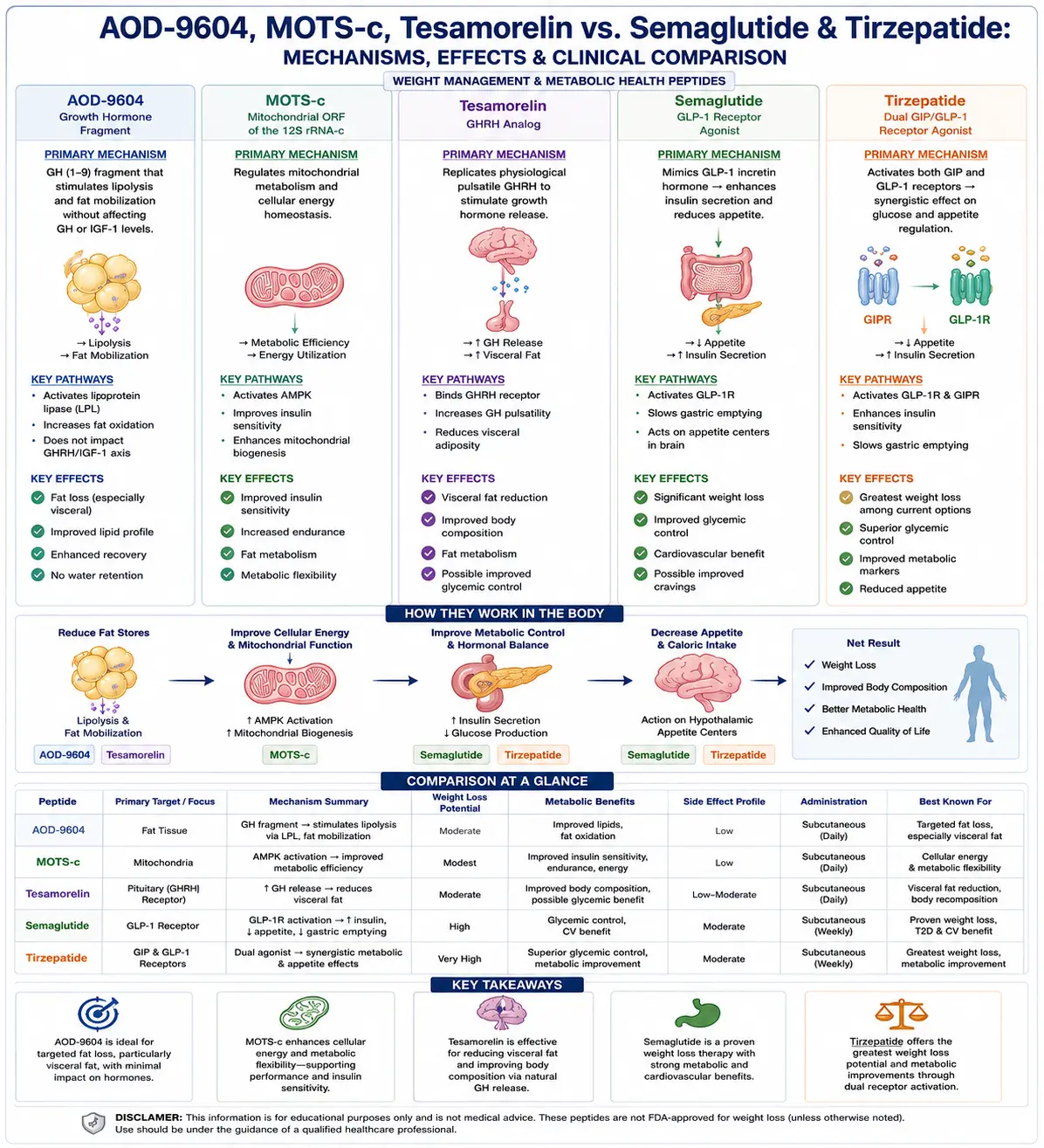
AOD-9604 vs MOTS-c vs Tesamorelin vs Semaglutide vs Tirzepatide: Mechanisms, Benefits, and Key Differences
Weight loss medicine has evolved dramatically over the past decade. While Semaglutide and Tirzepatide have become household names, a growing number of patients are also exploring metabolic peptides such as AOD-9604, MOTS-c, and Tesamorelin.
Although these therapies are often discussed together, they work through very different biological pathways. Some primarily target appetite. Others influence fat metabolism. Others improve mitochondrial efficiency, growth hormone signaling, or body composition.
Understanding how each therapy works can help explain why their results, benefits, and side effect profiles differ.
Understanding the Five Major Metabolic Peptides
These therapies can be divided into three broad categories:
- Fat mobilization — AOD-9604
- Metabolic optimization — MOTS-c
- Growth hormone–related body composition therapy — Tesamorelin
- Appetite and weight loss medications — Semaglutide, Tirzepatide
Each acts on a different aspect of energy balance and body composition.
How AOD-9604 Works
AOD-9604 is a modified fragment of human growth hormone derived from amino acids 176-191 of the HGH molecule. Unlike full growth hormone, AOD-9604 was designed to target fat metabolism without significantly affecting growth hormone or IGF-1 levels.
Proposed mechanisms of AOD-9604:
- Stimulates lipolysis (fat breakdown)
- Increases fat oxidation
- Promotes mobilization of stored fat
- Influences lipid metabolism
Importantly, AOD-9604 does not appear to significantly increase growth hormone levels, IGF-1 levels, water retention, or organ growth.
Potential benefits of AOD-9604:
- Targeted fat loss
- Improved body composition
- Minimal hormonal effects
- Low incidence of systemic side effects
AOD-9604 is generally viewed as a body-composition peptide rather than a major weight-loss medication.
How MOTS-c Works
MOTS-c is fundamentally different from most peptides. It is a mitochondrial-derived peptide encoded by mitochondrial DNA. Rather than targeting appetite or hormones, MOTS-c primarily affects cellular metabolism.
Proposed mechanisms of MOTS-c:
- Activates AMPK
- Improves insulin sensitivity
- Enhances glucose utilization
- Increases metabolic flexibility
- Improves mitochondrial efficiency
- Supports exercise performance
Why AMPK matters: AMPK is often called the body's metabolic master switch. When activated, AMPK promotes fat utilization, glucose uptake, improved energy production, and better metabolic efficiency. This is one reason MOTS-c is frequently discussed in longevity, performance, and metabolic-health communities.
Potential benefits of MOTS-c:
- Improved insulin sensitivity
- Better glucose control
- Increased exercise capacity
- Enhanced mitochondrial function
- Improved metabolic flexibility
Unlike Semaglutide or Tirzepatide, MOTS-c does not primarily work by reducing appetite.
How Tesamorelin Works
Tesamorelin is a Growth Hormone Releasing Hormone (GHRH) analog. It stimulates the pituitary gland to release growth hormone in a physiologic, pulsatile manner.
Proposed mechanisms of Tesamorelin:
- Activates GHRH receptors
- Increases endogenous GH release
- Elevates IGF-1 production
- Promotes lipolysis
- Reduces visceral adipose tissue
Why Tesamorelin is unique: Unlike most weight-loss therapies, Tesamorelin appears particularly effective at reducing visceral fat — the deep abdominal fat surrounding internal organs that is strongly associated with insulin resistance, cardiovascular disease, and metabolic syndrome.
Potential benefits of Tesamorelin:
- Reduced visceral fat
- Improved body composition
- Enhanced fat metabolism
- Possible improvement in metabolic markers
Tesamorelin is FDA-approved for HIV-associated lipodystrophy but is increasingly discussed in body-composition medicine.
How Semaglutide Works
Semaglutide is a GLP-1 receptor agonist. It mimics the naturally occurring incretin hormone GLP-1.
Mechanisms of Semaglutide:
- Slows gastric emptying
- Reduces appetite
- Improves satiety
- Increases insulin secretion
- Improves blood sugar control
Why Semaglutide produces weight loss: The primary mechanism is appetite reduction. Patients often report reduced hunger, smaller meal sizes, fewer cravings, and lower overall caloric intake.
Potential benefits of Semaglutide:
- Significant weight loss
- Improved glucose control
- Cardiovascular benefits
- Reduced appetite
How Tirzepatide Works
Tirzepatide is currently one of the most effective medical weight-loss therapies available. Unlike Semaglutide, Tirzepatide activates two receptors.
Mechanisms of Tirzepatide:
- GLP-1 receptors
- GIP receptors
This dual action produces powerful effects on appetite regulation, insulin sensitivity, blood sugar control, and energy balance.
Why Tirzepatide often outperforms Semaglutide: The additional GIP receptor activity appears to enhance metabolic effects beyond GLP-1 activation alone. Clinical trials have demonstrated some of the largest weight-loss results ever seen with a pharmaceutical therapy.
Potential benefits of Tirzepatide:
- Greater weight loss than Semaglutide in many studies
- Improved glycemic control
- Reduced appetite
- Improved metabolic markers
Comparing These Five Therapies
| Therapy | Primary Target | Main Goal | |---|---|---| | AOD-9604 | Fat metabolism | Fat mobilization | | MOTS-c | Mitochondria / AMPK | Metabolic optimization | | Tesamorelin | GHRH receptor | Reduce visceral fat | | Semaglutide | GLP-1 receptor | Appetite reduction | | Tirzepatide | GLP-1 + GIP receptors | Maximum weight loss |
Which Therapy Produces the Most Weight Loss?
Based on current clinical evidence, the rough ordering from largest to smallest weight-loss effect is:
- Tirzepatide — highest average weight loss
- Semaglutide — significant weight loss
- Tesamorelin — moderate weight loss, primarily through visceral fat reduction
- AOD-9604 — primarily body composition effects
- MOTS-c — primarily metabolic and energy effects rather than pure weight reduction
AOD-9604 and MOTS-c are generally not considered replacements for GLP-1 medications in patients seeking substantial weight reduction.
Which Therapy Is Best for Visceral Fat?
Tesamorelin has the strongest evidence specifically for reducing visceral adipose tissue. This makes it particularly interesting for central obesity, metabolic syndrome, and body composition optimization.
Which Therapy Is Best for Metabolic Health?
For metabolic optimization rather than pure weight loss:
- MOTS-c may improve mitochondrial efficiency
- Tesamorelin may improve body composition
- Semaglutide improves glucose control
- Tirzepatide offers the strongest overall metabolic effects
Frequently Asked Questions
Is AOD-9604 the same as growth hormone?
No. AOD-9604 is a small fragment of the growth hormone molecule and does not appear to significantly increase GH or IGF-1 levels.
Is MOTS-c a GLP-1 medication?
No. MOTS-c works through mitochondrial and AMPK signaling rather than appetite pathways.
Does Tesamorelin increase growth hormone?
Yes. Tesamorelin stimulates physiologic release of endogenous growth hormone.
Which therapy causes the greatest weight loss?
Current evidence suggests Tirzepatide produces the greatest average weight loss.
Which therapy is best for visceral fat?
Tesamorelin has some of the strongest evidence for specifically reducing visceral abdominal fat.
Can these therapies be combined?
In certain circumstances, clinicians may combine therapies that target different pathways. However, treatment decisions should always be individualized and medically supervised.
The Bottom Line
Although AOD-9604, MOTS-c, Tesamorelin, Semaglutide, and Tirzepatide are often discussed together, they serve very different purposes.
- AOD-9604 primarily targets fat metabolism
- MOTS-c focuses on mitochondrial function and metabolic efficiency
- Tesamorelin increases physiologic growth hormone release and reduces visceral fat
- Semaglutide reduces appetite through GLP-1 signaling
- Tirzepatide combines GLP-1 and GIP receptor activation and currently delivers some of the most impressive weight-loss results seen in modern medicine
Understanding these differences is essential when choosing the right therapy for weight loss, metabolic health, body composition, or long-term wellness goals.
Related reading:
- CJC-1295 vs Ipamorelin vs Sermorelin vs IGF-1 LR3 — the GH/IGF-1 axis explained
- BPC-157 vs GHK-Cu vs TB-500 — tissue repair peptide mechanisms
- Epitalon vs Kisspeptin-10 vs NAD+ — longevity pathways explained
- DSIP Peptide for Sleep — delta sleep, HPA-axis, and recovery
- KPV vs LL-37 vs Thymosin Alpha-1 — immune-supporting peptides
- Peptide Therapy Education — 23 active compounds
Considering Medical Weight Loss on Long Island?
If you've tried diet and exercise without sustainable results — or you're researching GLP-1 medications, metabolic peptides, or body-composition therapies — a single consultation can clarify which path actually fits your physiology, your medical history, and your goals.
Dr. Rubin sees patients at our Garden City and New Hyde Park offices and serves the greater Nassau County and Queens area. Call 516-492-3100 or text 516-206-0774 to schedule a consultation, or complete the peptide intake form online before your visit to save time in the office.
Medical Disclaimer
This article is for educational purposes only and does not constitute medical advice. Peptide therapies and weight-loss medications may not be appropriate for every patient. Some compounds discussed are not FDA-approved for weight management. Always consult a qualified healthcare professional before beginning any treatment program.
Written by Dr. Edward Rubin, MD — board-certified in Pain Medicine and Anesthesiology, with fellowship training at Cornell, Columbia, Hospital for Special Surgery, and Memorial Sloan Kettering. Dr. Rubin has been treating patients on Long Island for over 20 years.