




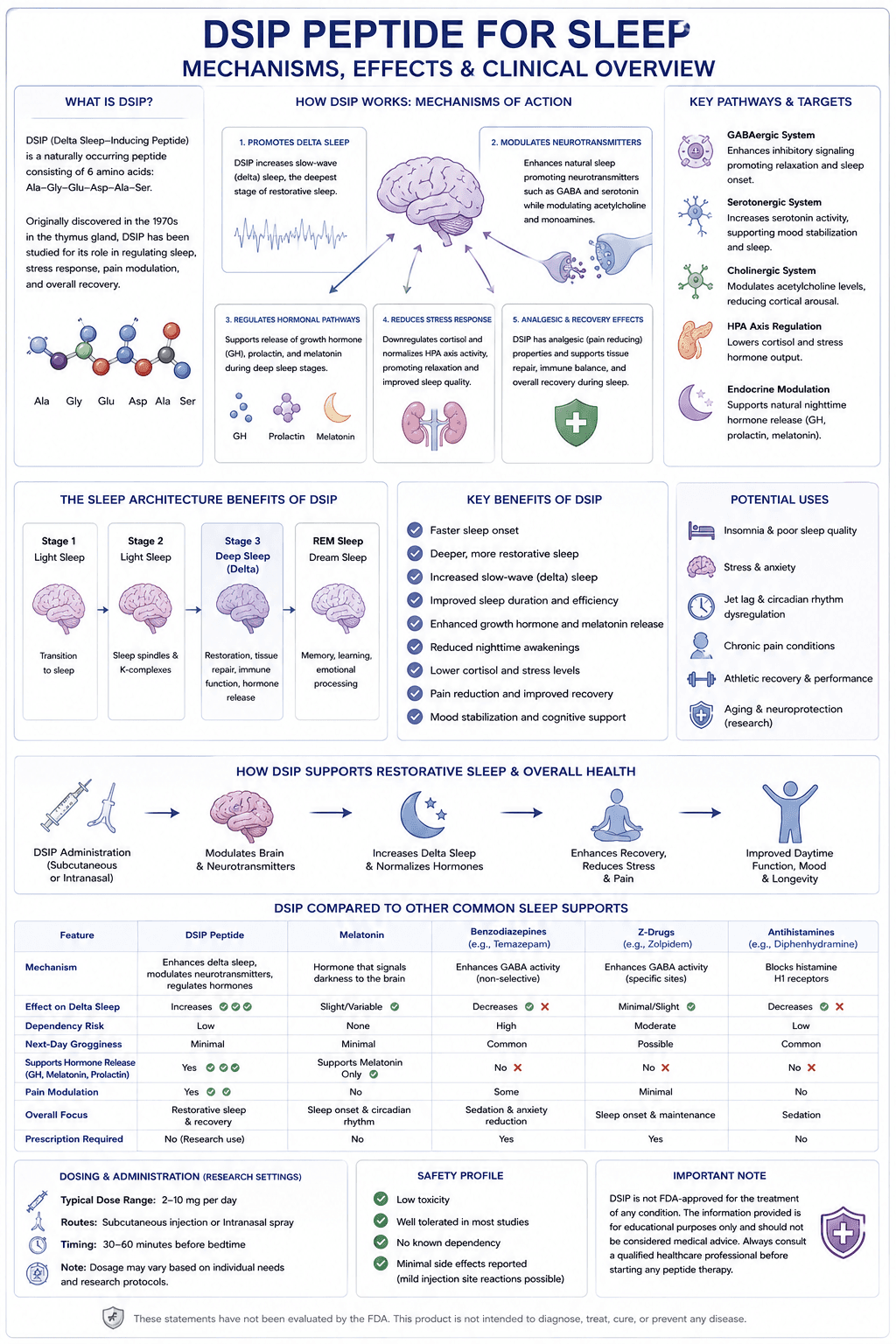
Sleep is one of the most important pillars of human health. Poor sleep has been linked to impaired recovery, reduced cognitive performance, increased inflammation, hormonal dysfunction, metabolic disease, and accelerated aging.
While most sleep treatments focus on sedation, DSIP (Delta Sleep-Inducing Peptide) is often discussed as a peptide that may support the body's natural sleep architecture. Unlike traditional sleep medications, DSIP has been studied for its potential role in deep sleep regulation, stress response, hormone balance, and recovery.
Although research remains limited, DSIP continues to generate interest within peptide medicine, longevity, and performance communities.
What Is DSIP?
DSIP stands for Delta Sleep-Inducing Peptide. It is a naturally occurring neuropeptide first identified in the 1970s and has been investigated for its role in sleep regulation, stress adaptation, endocrine signaling, and recovery.
DSIP consists of six amino acids: alanine, glycine, glutamic acid, aspartic acid, alanine, and serine.
Researchers originally discovered DSIP because of its apparent relationship with slow-wave sleep — the deepest, most restorative stage of sleep, also known as delta sleep.
Why Delta Sleep Matters
Sleep occurs in multiple stages. The deepest and most restorative stage is slow-wave sleep, or delta sleep. During this phase:
- Growth hormone release peaks
- Tissue repair accelerates
- Immune function improves
- Memory consolidation occurs
- Physical recovery is enhanced
Many sleep medications can induce sedation without necessarily improving restorative sleep quality. DSIP is often discussed because it may influence the architecture of sleep rather than simply causing drowsiness.
How DSIP Works
One challenge with DSIP research is that its exact receptor and mechanism have never been fully established. However, several biological pathways have been proposed.
Neurotransmitter modulation: DSIP appears to influence several neurotransmitter systems involved in sleep and wakefulness. Research suggests interactions with GABAergic, serotonergic, cholinergic, and monoaminergic signaling.
These systems help regulate sleep initiation, sleep maintenance, mood, cognitive function, and the stress response.
DSIP and Deep Sleep
The hallmark feature associated with DSIP is its potential ability to enhance slow-wave sleep. Slow-wave sleep is characterized by high-amplitude delta brain waves and is considered the most restorative stage of sleep.
Potential benefits of increased delta sleep:
- Improved physical recovery
- Better hormone regulation
- Enhanced immune function
- Improved daytime energy
- Better athletic recovery
This is why DSIP is frequently discussed among athletes, shift workers, and individuals seeking recovery optimization.
DSIP and the Stress Response
Another proposed mechanism involves regulation of the hypothalamic-pituitary-adrenal (HPA) axis, which controls cortisol production, stress adaptation, sleep-wake rhythms, and energy balance.
Research suggests DSIP may help normalize HPA-axis activity and reduce excessive stress signaling.
Potential effects:
- Reduced nighttime cortisol
- Improved relaxation
- Easier sleep onset
- Improved sleep quality
This proposed stress-modulating effect distinguishes DSIP from many traditional sleep aids.
DSIP and Hormonal Regulation
Several studies suggest DSIP may influence endocrine function during sleep. Hormones that have been investigated include growth hormone, prolactin, melatonin, and cortisol.
Because many critical hormonal processes occur during deep sleep, improving sleep architecture may indirectly support hormone balance. This area remains under active investigation.
DSIP and Recovery
Beyond sleep itself, DSIP has been studied for possible effects on recovery. Researchers have explored potential roles in pain modulation, stress resilience, physical recovery, immune regulation, and neurologic function.
Some studies suggest DSIP may possess mild analgesic properties and may influence the body's response to physiologic stress. These findings remain preliminary and require further human research.
Potential Benefits of DSIP
Based on current research, potential benefits may include:
- Faster sleep onset
- Deeper sleep
- Increased slow-wave sleep
- Improved sleep efficiency
- Reduced nighttime awakenings
- Improved recovery
- Reduced stress response
- Enhanced mood regulation
- Better daytime energy
Importantly, not every study has shown consistent results, and DSIP remains an investigational peptide.
DSIP vs Melatonin
DSIP and melatonin are often confused, but they work differently.
Melatonin primarily signals darkness to the brain and helps regulate circadian rhythm. Its primary role is helping initiate sleep.
DSIP appears to be more closely associated with sleep quality and sleep architecture. Rather than signaling bedtime, DSIP may influence the depth and restorative quality of sleep itself.
This distinction is one reason the two compounds are frequently discussed together.
DSIP vs Prescription Sleep Medications
Traditional sleep medications often work through sedation — benzodiazepines, Z-drugs, and certain antihistamines, for example.
While effective for inducing sleep, these medications may not always improve restorative sleep architecture, and several carry dependency risk and next-day grogginess as known limitations.
DSIP has been studied because it may support physiologic sleep processes rather than simply inducing sedation. However, much more research is needed before definitive conclusions can be made — and unlike prescription sleep aids, DSIP is not FDA-approved for clinical use.
Is DSIP FDA Approved?
No. DSIP is not FDA-approved for the treatment of insomnia, sleep disorders, or any other medical condition. Most use currently occurs in research, investigational, or specialized peptide medicine settings.
Patients should avoid purchasing peptides from unregulated online sources because purity, potency, and safety cannot be guaranteed.
Frequently Asked Questions
What does DSIP stand for?
DSIP stands for Delta Sleep-Inducing Peptide.
Does DSIP make you sleepy?
DSIP is not believed to function like a traditional sedative. Research suggests it may influence sleep quality and deep sleep rather than simply causing drowsiness.
What stage of sleep does DSIP affect?
DSIP is most commonly associated with slow-wave sleep, also known as delta sleep.
Is DSIP the same as melatonin?
No. Melatonin primarily regulates circadian rhythm and sleep timing. DSIP appears to influence sleep architecture and restorative sleep quality.
Can DSIP reduce cortisol?
Some research suggests DSIP may influence HPA-axis regulation and stress hormone activity, but additional human studies are needed.
Is DSIP approved for insomnia?
No. DSIP is not FDA-approved for insomnia treatment.
The Bottom Line
DSIP is one of the most intriguing sleep-related peptides currently being studied. Unlike many sleep aids that primarily induce sedation, DSIP appears to interact with sleep architecture, stress pathways, neurotransmitter systems, and hormone regulation.
Research suggests potential roles in deep sleep enhancement, stress reduction, recovery optimization, hormonal balance, and sleep quality improvement. However, much of the available evidence remains limited, and further human studies are needed to fully understand its therapeutic potential.
For individuals interested in peptide-based approaches to sleep optimization, understanding both the promise and the limitations of DSIP is essential.
Related reading:
- CJC-1295 vs Ipamorelin vs Sermorelin vs IGF-1 LR3 — the GH/IGF-1 axis explained
- BPC-157 vs GHK-Cu vs TB-500 — tissue repair peptide mechanisms
- Epitalon vs Kisspeptin-10 vs NAD+ — longevity pathways explained
- AOD-9604 vs MOTS-c vs Tesamorelin vs Semaglutide vs Tirzepatide — weight loss & metabolic peptides
- KPV vs LL-37 vs Thymosin Alpha-1 — immune-supporting peptides
- Peptide Therapy Education — 23 active compounds
Struggling With Sleep — or Recovery That Isn't Keeping Up?
Poor sleep affects everything else: pain tolerance, recovery from training or injury, hormone balance, mood, cognitive performance. Treating it with the right tool — whether that's behavioral changes, evaluation of an underlying cause, or considering a peptide protocol like DSIP — starts with a real conversation, not a one-size-fits-all script.
Dr. Rubin sees patients at our Garden City and New Hyde Park offices and serves the greater Nassau County and Queens area. Call 516-492-3100 or text 516-206-0774 to schedule a consultation, or complete the peptide intake form online before your visit to save time in the office.
Medical Disclaimer
This article is for educational purposes only and does not constitute medical advice. DSIP is not FDA-approved for the treatment of insomnia or any medical condition. Peptide therapies may not be appropriate for every patient. Always consult a qualified healthcare professional before beginning any treatment program.
Written by Dr. Edward Rubin, MD — board-certified in Pain Medicine and Anesthesiology, with fellowship training at Cornell, Columbia, Hospital for Special Surgery, and Memorial Sloan Kettering. Dr. Rubin has been treating patients on Long Island for over 20 years.