




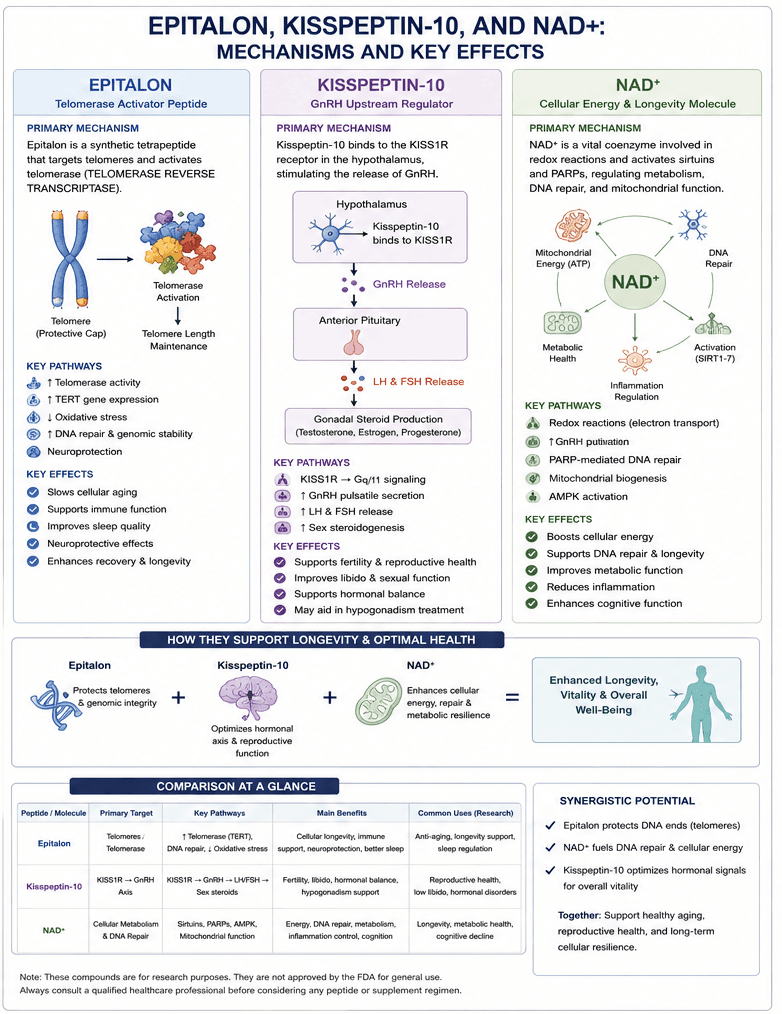
Epitalon, Kisspeptin-10, and NAD+ are often discussed in anti-aging, hormone optimization, fertility, recovery, and longevity medicine. Although they are sometimes grouped together, they work through very different biological systems.
- Epitalon is most commonly associated with telomere biology, pineal signaling, melatonin regulation, and cellular aging.
- Kisspeptin-10 acts upstream in the reproductive hormone axis by stimulating GnRH signaling.
- NAD+ is not a peptide. It is a critical coenzyme involved in cellular energy production, DNA repair, mitochondrial function, and healthy aging pathways.
Understanding how each compound works helps explain why they may have different clinical and research applications.
The Big Picture: Three Different Longevity Pathways
These compounds can be understood through three separate biological systems:
- Epitalon — telomeres, pineal gland signaling, melatonin, cellular aging
- Kisspeptin-10 — hypothalamus, GnRH, LH, FSH, reproductive hormones
- NAD+ — mitochondria, energy metabolism, DNA repair, sirtuins, PARPs
Together, they represent three major categories of health optimization: cellular aging, hormonal regulation, and metabolic resilience.
How Epitalon Works
Epitalon, also called Epithalon, is a synthetic tetrapeptide made from four amino acids.
It was originally studied in relation to pineal gland biology, aging, melatonin regulation, and telomere maintenance.
Proposed mechanisms of Epitalon:
- Telomerase activation
- Telomere length maintenance
- Pineal gland signaling
- Melatonin rhythm regulation
- Antioxidant activity
- DNA repair support
- Cellular aging modulation
Why telomeres matter: Telomeres are protective caps at the ends of chromosomes. As cells divide, telomeres gradually shorten. When telomeres become too short, cells may enter senescence — a state where they no longer divide normally and may contribute to aging-related dysfunction. Epitalon has been studied for its potential ability to influence telomerase, the enzyme that helps maintain telomere length.
Epitalon and melatonin: Epitalon is also linked to pineal gland function. The pineal gland produces melatonin, a hormone involved in sleep-wake regulation, circadian rhythm, antioxidant defense, and immune signaling. This is why Epitalon is often discussed in the context of:
- Sleep quality
- Circadian rhythm
- Healthy aging
- Cellular repair
- Longevity support
However, human clinical evidence remains limited, and many claims around Epitalon are still considered investigational.
How Kisspeptin-10 Works
Kisspeptin-10 is a short active fragment of the naturally occurring kisspeptin peptide. Its primary role is in reproductive hormone signaling.
Kisspeptin-10 binds to the KISS1 receptor (also known as GPR54), located on or near GnRH neurons in the hypothalamus. This stimulates the release of gonadotropin-releasing hormone, or GnRH.
GnRH then signals the anterior pituitary gland to release:
- Luteinizing hormone (LH)
- Follicle-stimulating hormone (FSH)
LH and FSH then act on the gonads to regulate production of sex hormones such as testosterone, estrogen, and progesterone.
Proposed mechanisms of Kisspeptin-10:
- GnRH release
- LH secretion
- FSH secretion
- Gonadal steroid production
- Fertility signaling
- Puberty and reproductive axis regulation
- Libido and sexual function pathways
Why Kisspeptin-10 is different from testosterone: Kisspeptin-10 does not directly replace testosterone. Instead, it acts higher up in the hormonal signaling cascade by stimulating the body's own reproductive hormone axis. This makes it mechanistically different from testosterone replacement therapy, which supplies testosterone directly from outside the body. Kisspeptin-10 is best understood as an upstream hypothalamic signal rather than a direct hormone replacement.
How NAD+ Works
NAD+ stands for nicotinamide adenine dinucleotide.
Unlike Epitalon and Kisspeptin-10, NAD+ is not a peptide. It is a coenzyme found in every cell of the body. NAD+ is essential for energy metabolism and cellular repair.
Proposed mechanisms of NAD+:
- Mitochondrial energy production
- Redox reactions
- ATP generation
- Sirtuin activation
- PARP-mediated DNA repair
- Cellular stress resistance
- Inflammation regulation
- Mitochondrial biogenesis
- Healthy aging pathways
NAD+ and mitochondrial energy: Mitochondria use NAD+ and NADH to transfer electrons during energy production. This process helps generate ATP, the primary energy currency of the cell. When NAD+ availability declines, mitochondrial function, energy production, and cellular repair capacity may become impaired.
NAD+ and DNA repair: NAD+ is also consumed by enzymes involved in DNA repair, especially PARPs. When cells experience oxidative stress, inflammation, or DNA damage, NAD+ demand may increase. This is one reason NAD+ has become a major focus in aging, fatigue, neurodegeneration, metabolic health, and recovery research.
Comparing Epitalon, Kisspeptin-10, and NAD+
| Compound | Primary System | Main Target | Key Biological Theme | |---|---|---|---| | Epitalon | Cellular aging and circadian biology | Telomerase, pineal gland, melatonin pathways | Telomere support and longevity signaling | | Kisspeptin-10 | Reproductive hormone axis | KISS1R/GPR54 → GnRH → LH/FSH | Fertility and sex hormone regulation | | NAD+ | Cellular metabolism | Mitochondria, sirtuins, PARPs | Energy, DNA repair, and metabolic resilience |
Can These Compounds Work Together?
Mechanistically, these compounds act in different systems.
- Epitalon is associated with telomeres, pineal signaling, and cellular aging
- Kisspeptin-10 is associated with reproductive hormone signaling through the hypothalamic-pituitary-gonadal axis
- NAD+ is associated with mitochondrial function, DNA repair, and cellular metabolism
Because they target different biological pathways, they are sometimes discussed together in longevity and optimization protocols. However, combining experimental therapies should only be done under qualified medical supervision.
Are These FDA-Approved?
Many peptides and longevity compounds discussed online are not FDA-approved for broad anti-aging, fertility, or performance-enhancement use.
Regulatory status can vary depending on the compound, formulation, route of administration, and intended use. Patients should be cautious with unregulated online peptide sources, especially injectable products.
Frequently Asked Questions
Is Epitalon the same as NAD+?
No. Epitalon is a peptide associated with telomere and pineal gland biology. NAD+ is a coenzyme involved in energy production, DNA repair, and mitochondrial function.
Is Kisspeptin-10 a testosterone replacement?
No. Kisspeptin-10 does not directly replace testosterone. It acts upstream by stimulating GnRH, which can increase LH and FSH signaling.
What is Epitalon used for?
Epitalon is most commonly discussed for longevity, telomere support, sleep-wake rhythm, melatonin regulation, and cellular aging research.
What does NAD+ do in the body?
NAD+ helps cells produce energy, repair DNA, regulate inflammation, activate sirtuins, and maintain mitochondrial function.
Which compound is most related to fertility?
Kisspeptin-10 is most directly related to fertility and reproductive hormone signaling.
Which compound is most related to cellular energy?
NAD+ is most directly related to cellular energy production and mitochondrial function.
Which compound is most related to telomeres?
Epitalon is most commonly associated with telomerase activation and telomere maintenance.
The Bottom Line
Epitalon, Kisspeptin-10, and NAD+ are often discussed together in longevity and hormone optimization, but they work through very different biological pathways.
- Epitalon is linked to telomere maintenance, pineal signaling, melatonin rhythm, and cellular aging
- Kisspeptin-10 acts upstream in the reproductive hormone axis by stimulating GnRH, LH, and FSH signaling
- NAD+ supports mitochondrial energy production, DNA repair, sirtuin activity, and cellular resilience
Understanding these differences is essential before considering any peptide or longevity-focused protocol.
Related reading:
- CJC-1295 vs Ipamorelin vs Sermorelin vs IGF-1 LR3 — the GH/IGF-1 axis explained
- BPC-157 vs GHK-Cu vs TB-500 — tissue repair peptide mechanisms
- AOD-9604 vs MOTS-c vs Tesamorelin vs Semaglutide vs Tirzepatide — weight loss & metabolic peptides
- DSIP Peptide for Sleep — delta sleep, HPA-axis, and recovery
- KPV vs LL-37 vs Thymosin Alpha-1 — immune-supporting peptides
- Peptide Therapy Education — 23 active compounds
Building a Longevity Protocol That Actually Fits You?
Longevity is having a moment, and the noise is louder than ever. Telomere support, hormonal optimization, mitochondrial health — there's a real biology behind each one, but the right starting point depends on your labs, your medical history, and what you're actually trying to change.
Dr. Rubin sees patients at our Garden City and New Hyde Park offices and serves the greater Nassau County and Queens area. Call 516-492-3100 or text 516-206-0774 to schedule a consultation, or complete the peptide intake form online before your visit to save time in the office.
Medical Disclaimer
This article is for educational purposes only and does not constitute medical advice. Peptide therapies, NAD+ protocols, and longevity treatments may not be FDA-approved for all uses and may not be appropriate for every patient. Always consult a qualified healthcare professional before beginning any treatment.
Written by Dr. Edward Rubin, MD — board-certified in Pain Medicine and Anesthesiology, with fellowship training at Cornell, Columbia, Hospital for Special Surgery, and Memorial Sloan Kettering. Dr. Rubin has been treating patients on Long Island for over 20 years.