




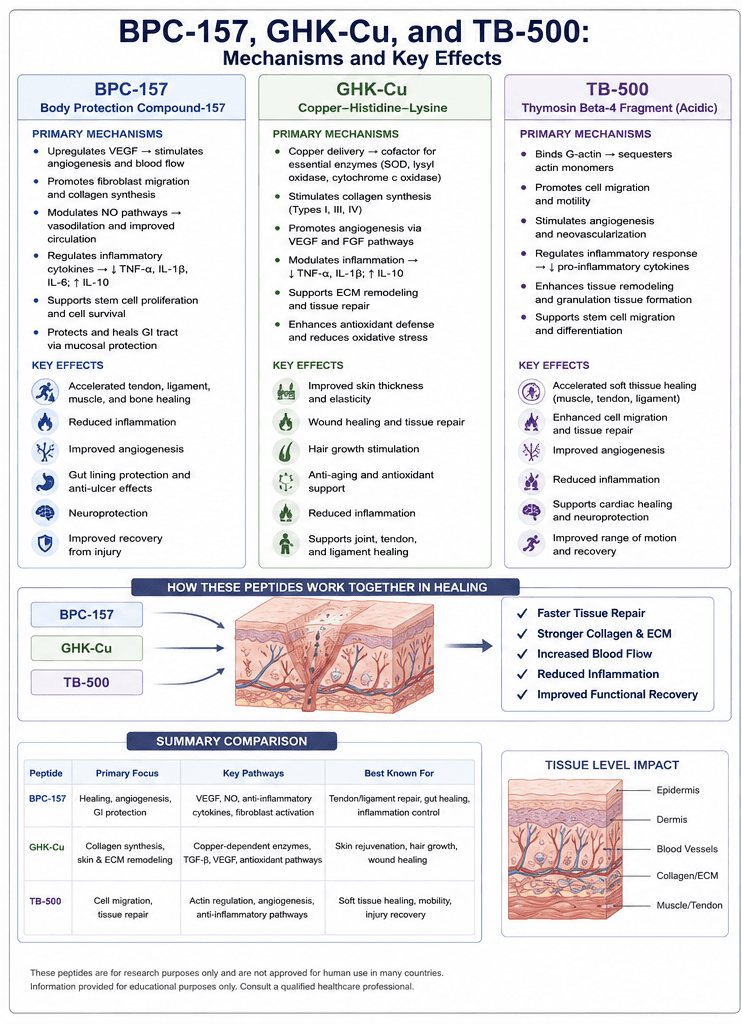
BPC-157, GHK-Cu, and TB-500 are three of the most discussed peptides in regenerative medicine, sports recovery, aesthetics, and tissue repair.
Although they are often grouped together, they do not work the same way. Each peptide appears to influence healing through different biological pathways, including blood vessel formation, collagen remodeling, cellular migration, inflammation regulation, and extracellular matrix repair.
The Tissue Repair Process Explained
Healing requires several coordinated steps:
- Inflammation control
- New blood vessel formation
- Fibroblast activation
- Collagen production
- Cellular migration
- Extracellular matrix remodeling
- Tissue maturation
BPC-157, GHK-Cu, and TB-500 appear to influence different parts of this repair process.
How BPC-157 Works
BPC-157, also known as Body Protection Compound-157, is a synthetic peptide derived from a naturally occurring gastric protein fragment.
It is best known for its proposed role in tissue protection, angiogenesis, gastrointestinal repair, and tendon-ligament healing.
Proposed mechanisms of BPC-157:
- VEGF signaling and angiogenesis
- Nitric oxide modulation
- Fibroblast migration
- Collagen organization
- Anti-inflammatory signaling
- Gastrointestinal mucosal protection
Why angiogenesis matters: Angiogenesis is the formation of new blood vessels. In injured tissue, improved blood supply may help deliver oxygen, nutrients, immune cells, and repair signals to the healing area. This is one reason BPC-157 is often discussed in relation to tendon, ligament, muscle, and gut tissue repair.
Key effects associated with BPC-157:
- Tendon and ligament repair support
- Muscle injury recovery
- Gut lining protection
- Inflammation modulation
- Improved tissue perfusion
- Possible neuroprotective effects
Importantly, much of the BPC-157 literature is preclinical — meaning it comes from animal or laboratory studies rather than large human clinical trials.
How GHK-Cu Works
GHK-Cu is a copper-binding peptide made from three amino acids: glycine, histidine, and lysine.
It naturally occurs in the human body and has been studied heavily in skin health, wound healing, collagen production, and tissue remodeling.
Proposed mechanisms of GHK-Cu:
GHK-Cu works largely through copper-dependent repair biology. Copper is an important cofactor for enzymes involved in:
- Collagen cross-linking
- Antioxidant defense
- Wound repair
- Extracellular matrix remodeling
GHK-Cu appears to support:
- Collagen synthesis
- Elastin production
- Glycosaminoglycan production
- Angiogenesis
- Antioxidant activity
- Matrix metalloproteinase regulation
Why GHK-Cu is popular in aesthetics: GHK-Cu is commonly discussed in skin rejuvenation because it may support skin thickness, elasticity, firmness, wound repair, hair follicle signaling, reduced inflammation, and improved skin texture.
Compared with many experimental peptides, GHK-Cu has a stronger history of study in skin biology and wound-healing models.
How TB-500 Works
TB-500 is a synthetic peptide fragment related to thymosin beta-4.
Thymosin beta-4 is a naturally occurring peptide involved in actin regulation, cell movement, angiogenesis, inflammation control, and tissue repair.
Proposed mechanisms of TB-500:
TB-500 is primarily discussed for its role in cell migration and cytoskeletal remodeling. It may influence:
- Actin binding
- Cell movement
- Endothelial cell migration
- New blood vessel formation
- Inflammation regulation
- Tissue remodeling
Why actin matters: Actin is one of the structural proteins cells use to move, change shape, and migrate into damaged tissue. During wound healing, cells must move into the injured area to rebuild tissue. By influencing actin dynamics, TB-500 may support the cellular movement needed for repair.
Key effects associated with TB-500:
- Soft tissue repair support
- Cell migration
- Angiogenesis
- Reduced inflammatory signaling
- Improved tissue remodeling
- Possible cardiac and neurologic repair effects in preclinical models
Like BPC-157, most TB-500 data remains preclinical.
Comparing BPC-157, GHK-Cu, and TB-500
| Peptide | Primary Focus | Key Pathways | Commonly Discussed Uses | |---|---|---|---| | BPC-157 | Tissue protection and angiogenesis | VEGF, nitric oxide, fibroblast migration | Tendons, ligaments, gut repair, injury recovery | | GHK-Cu | Collagen and skin remodeling | Copper enzymes, collagen, elastin, MMP regulation | Skin rejuvenation, wound healing, hair health | | TB-500 | Cell migration and tissue repair | Actin regulation, angiogenesis, inflammation control | Soft tissue recovery, mobility, muscle/tendon support |
Can These Peptides Work Together?
Mechanistically, these peptides appear to target different parts of the healing process.
- BPC-157 is often associated with vascular and protective signaling
- GHK-Cu is more closely associated with collagen, skin, and extracellular matrix remodeling
- TB-500 is more focused on actin, cell migration, and tissue repair dynamics
This is why they are sometimes discussed together in regenerative protocols. However, combining peptides should only be considered under medical supervision.
Are These Peptides FDA-Approved?
Many peptides discussed online are not FDA-approved for general clinical use.
Some may be used in research settings, compounded settings, or aesthetic contexts, but evidence quality, regulation, purity, dosing, and safety oversight can vary significantly.
Patients should avoid purchasing injectable peptides from unregulated online sources.
Frequently Asked Questions
Is BPC-157 the same as TB-500?
No. BPC-157 is primarily associated with angiogenesis, nitric oxide modulation, and tissue protection. TB-500 is associated more with actin regulation, cell migration, and soft tissue repair.
Is GHK-Cu only for skin?
No. GHK-Cu is best known for skin and wound-healing biology, but its mechanisms involve broader tissue remodeling, collagen synthesis, antioxidant support, and inflammation regulation.
Which peptide is most associated with collagen?
GHK-Cu is most directly associated with collagen synthesis and extracellular matrix remodeling.
Which peptide is most associated with angiogenesis?
BPC-157 and TB-500 are both associated with angiogenesis, but through different proposed mechanisms.
Which peptide is most associated with cell migration?
TB-500 is most closely associated with actin regulation and cellular migration.
Are these peptides proven in humans?
Human data is limited, especially for BPC-157 and TB-500. Much of the evidence comes from animal studies, cell studies, or early clinical research.
The Bottom Line
BPC-157, GHK-Cu, and TB-500 are often grouped together because they are all discussed in the context of healing and regeneration. However, their mechanisms are different.
- BPC-157 appears to influence angiogenesis, nitric oxide signaling, inflammation, and tissue protection
- GHK-Cu supports copper-dependent repair biology, collagen formation, antioxidant defense, and extracellular matrix remodeling
- TB-500 is most associated with actin regulation, cell migration, angiogenesis, and soft tissue repair
Understanding these differences helps explain why each peptide may have a different role in tissue repair and why medical supervision is important.
Related reading:
- CJC-1295 vs Ipamorelin vs Sermorelin vs IGF-1 LR3 — the GH/IGF-1 axis explained
- Epitalon vs Kisspeptin-10 vs NAD+ — longevity pathways explained
- AOD-9604 vs MOTS-c vs Tesamorelin vs Semaglutide vs Tirzepatide — weight loss & metabolic peptides
- DSIP Peptide for Sleep — delta sleep, HPA-axis, and recovery
- KPV vs LL-37 vs Thymosin Alpha-1 — immune-supporting peptides
- Peptide Therapy Education — 23 active compounds
- Stem Cell Therapy for Degenerative Disc Disease
Recovering from an Injury — or Trying to Stay Ahead of One?
Regenerative peptides aren't a substitute for diagnosis, imaging, and a real treatment plan. But when an injury, surgery, or chronic inflammation is genuinely on the table, the right peptide protocol — paired with the right interventional care — can change the trajectory.
Dr. Rubin sees patients at our Garden City and New Hyde Park offices and serves the greater Nassau County and Queens area. Call 516-492-3100 or text 516-206-0774 to schedule a consultation, or complete the peptide intake form online before your visit to save time in the office.
Medical Disclaimer
This article is for educational purposes only and does not constitute medical advice. Peptide therapies may not be FDA-approved for all uses and may not be appropriate for every patient. Always consult a qualified healthcare professional before beginning any treatment.
Written by Dr. Edward Rubin, MD — board-certified in Pain Medicine and Anesthesiology, with fellowship training at Cornell, Columbia, Hospital for Special Surgery, and Memorial Sloan Kettering. Dr. Rubin has been treating patients on Long Island for over 20 years.